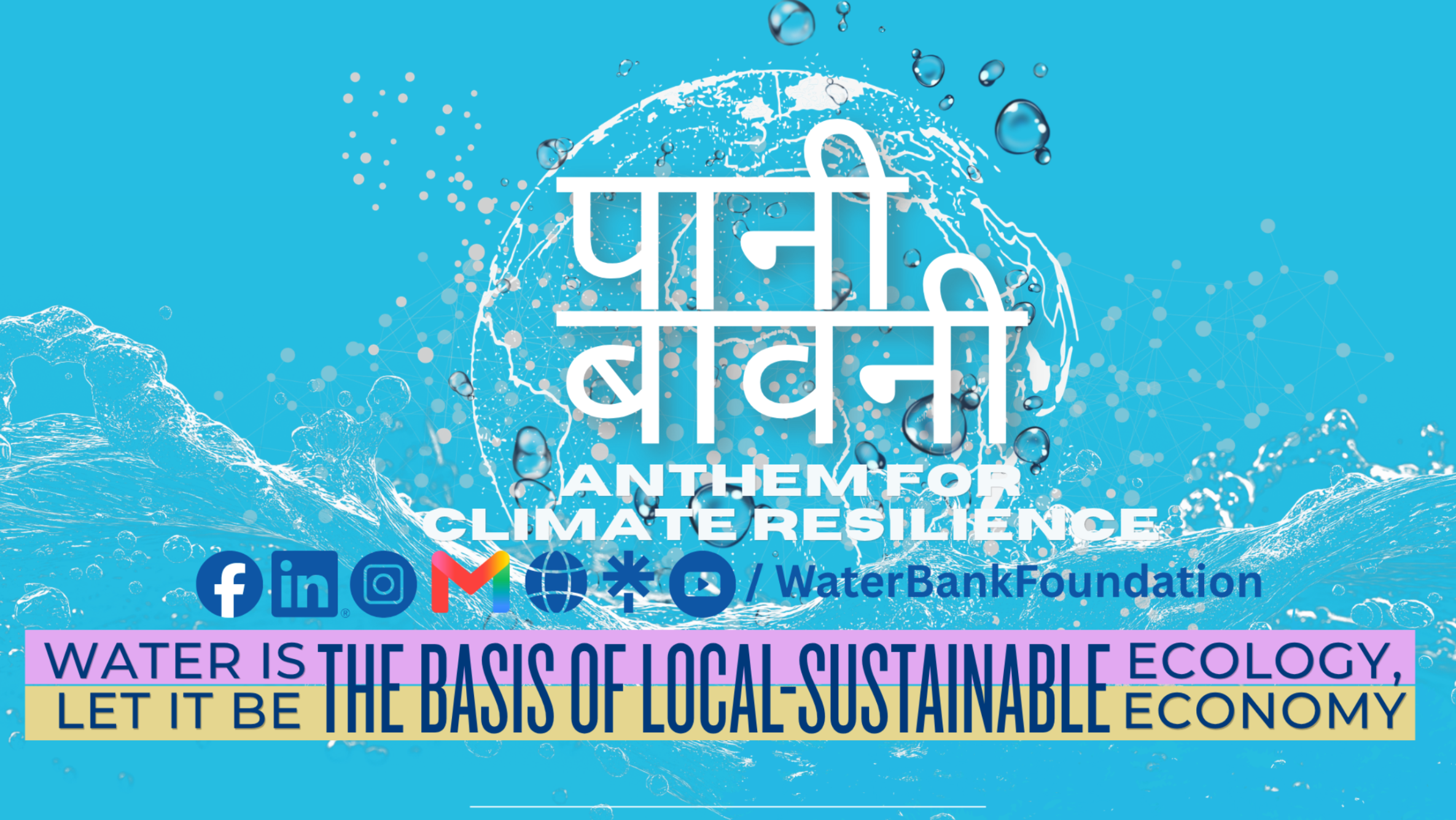
India's young people should not encounter climate change only as a chapter in a textbook. They should sing it, recite it, perform it, discuss it, act on it—and eventually make it part of their identity.
PaaniBAAWNI becomes the common cultural language through which thousands of schools and colleges across India can express:
Transforming initial emotional resonance into enduring ecological stewardship:
Students learn and collectively recite PaaniBAAWNI in classrooms, auditoriums, and campuses. Thousands of student voices eventually become a single national chorus.
No special infrastructure needed. A classroom screen or smart board is ready in seconds.
Synchronized lyrics appear clearly on the screen for students to follow along.
Students recite and sing as one collective voice, building deep mutual conviction.
A simple smartphone video captures the classroom or assembly performance.
Submitted to the national campaign to join the collective chorus of Indian youth.
The campaign shall not end when the music stops. Every participating student and institution is invited to undertake ground-level water-positive and nature-positive actions across 14 actionable pillars:
Capturing roof runoff and recharging shallow aquifer soak pits.
Mapping campus water inflows, storage tanks, and usage footprints.
Auditing, documenting, and repairing dripping plumbing fixtures.
Channeling rinse & wash water to campus gardens and green strips.
Reviving local village, municipal, or campus water recharge points.
De-silting, cleaning, and protecting degraded community water sources.
Planting indigenous species that rebuild groundwater tables.
Creating habitats for pollinators, beneficial insects, and native fauna.
Mulching, contour bunding, and preventing precious topsoil runoff.
Behavioral interventions to eliminate wasteful lifestyle water drain.
Safeguarding natural flood buffers, marshes, and riparian edges.
Net Zero waste: eliminating solid, liquid, and toxic drain at source.
Student citizen science tracking TDS, pH, contamination, and clarity.
Documenting neighborhood wells, aquifers, tanks, and streams.
Without measurable action, environmental campaigns fade into background noise. PaaniBAAWNI establishes a direct pipeline connecting emotion to ecological identity, and ecological identity to verified ground impact.
Students, classrooms, schools, and partner networks earn Rainbow Credits for verified water-positive and nature-positive actions, building verifiable ecological citizenship portfolios.
Complete group anthem recitation, record performance video, and submit to the national chorus.
Audit dripping taps or pipes and execute plumbing repair.
Comprehensive baseline inspection of inflows and daily consumption.
Student-led outreach in neighborhood, market, or village.
Creating or rejuvenating catchment filters and soak pits.
Planting native flora, moisture retainers, and pollinator habitats.
Demonstrating survival, ongoing stewardship, and plant care.
De-silting, rejuvenating, or reviving a natural waterbody.
Long-term institutional adoption and ecological upkeep.
A multi-level collaborative model connecting students, educational institutions, and partner networks into an expanding impact engine:
Each student who uploads their verified anthem recitation video directly earns 52 Rainbow Credits credited to their digital ecological portfolio.
The school automatically earns 25% of all credits accumulated by its enrolled students, incentivising campus-wide mobilization.
Schools earn 100 institutional credits every week by conducting collective student recitations in campus assemblies or periods.
Partner organisations (NGOs, trusts, and bodies) earn 25% of all credits accumulated by schools within their designated regional coverage.
This is the campaign's basic unit. A school doesn't need to organize a huge event. Just the PaaniBAAWNI digital kit with a smart board is enough to conduct a complete session in 40–45 minutes.
Everything your educators, teachers, and club facilitators need to lead an inspiring classroom recitation and action session.
Teams compete—not primarily against one another, but against their own baseline. The emphasis remains on measurable ecological outcomes, not spectacle.
“How much water can your campus save?” Measure, monitor, and plug baseline drain.
“How much rainwater can your campus capture?” Direct precipitation into productive aquifers.
“Turn your school campus free from waste generation: Solid waste, liquid waste, and gas emission.”
“How much habitat can you create?” Develop micro-forests, butterfly paths, and soil beds.
“What can your community do for its nearest river or wetland?” Adopt and protect natural waterways.
“What can students discover about their local water system?” Hydro-geological student discoveries.
Criteria-based designations, not merely marketing badges. Building a credible national network of ecological campuses.
We invite schools, colleges, NGOs, and education leaders to become early founding members of India's Youth Water & Climate Resilience Movement.
Schools, colleges, school networks, universities, and educational trusts.
Universities, environmental institutions, water experts, and climate scientists.
Water NGOs, watershed organisations, biodiversity groups, and local communities.
Artists, musicians, creators, media organisations, and youth platforms.
Government departments, national missions, and public sector institutions.
One Voice. One Generation. A Resilient Future.
India's ecological future will not be secured only by policies, technologies and infrastructure. It will also depend upon the ecological values of a generation. A generation that understands that water is not merely a resource. That rivers are not merely channels. That forests are not merely land. That biodiversity is not merely a statistic. And that climate resilience begins with the relationship between people and the natural world around them.
PaaniBAAWNI is an anthem for this generation. Through a simple and powerful classroom experience, young people come together to learn and collectively recite the anthem. Different schools. Different cities. Different backgrounds. One voice. The voices of thousands of classrooms become a national expression of youth commitment to water and climate resilience.
But the song is only the beginning. PaaniBAAWNI moves from Voice to Action. Students are invited to undertake practical water-positive and nature-positive actions in their schools, campuses and communities. Every meaningful action earns Rainbow Credits—recognising ecological citizenship.
To build India's largest youth-led cultural movement for water and climate resilience. A movement that begins in the classroom and extends into the community. A movement that connects emotion with knowledge, knowledge with action, and action with ecological citizenship.
One classroom can raise a voice.
One school can begin an action.
One generation can change its relationship with nature.
Let millions of young Indians find their voice for water.
Let that voice become action.
Let that action become a culture.
PAANI BAAWNI — Gao. Samjho. Badlo.
India's Youth Movement for Water & Climate Resilience
Select your category below to register. School registrations are synchronized directly into our official CRM database.