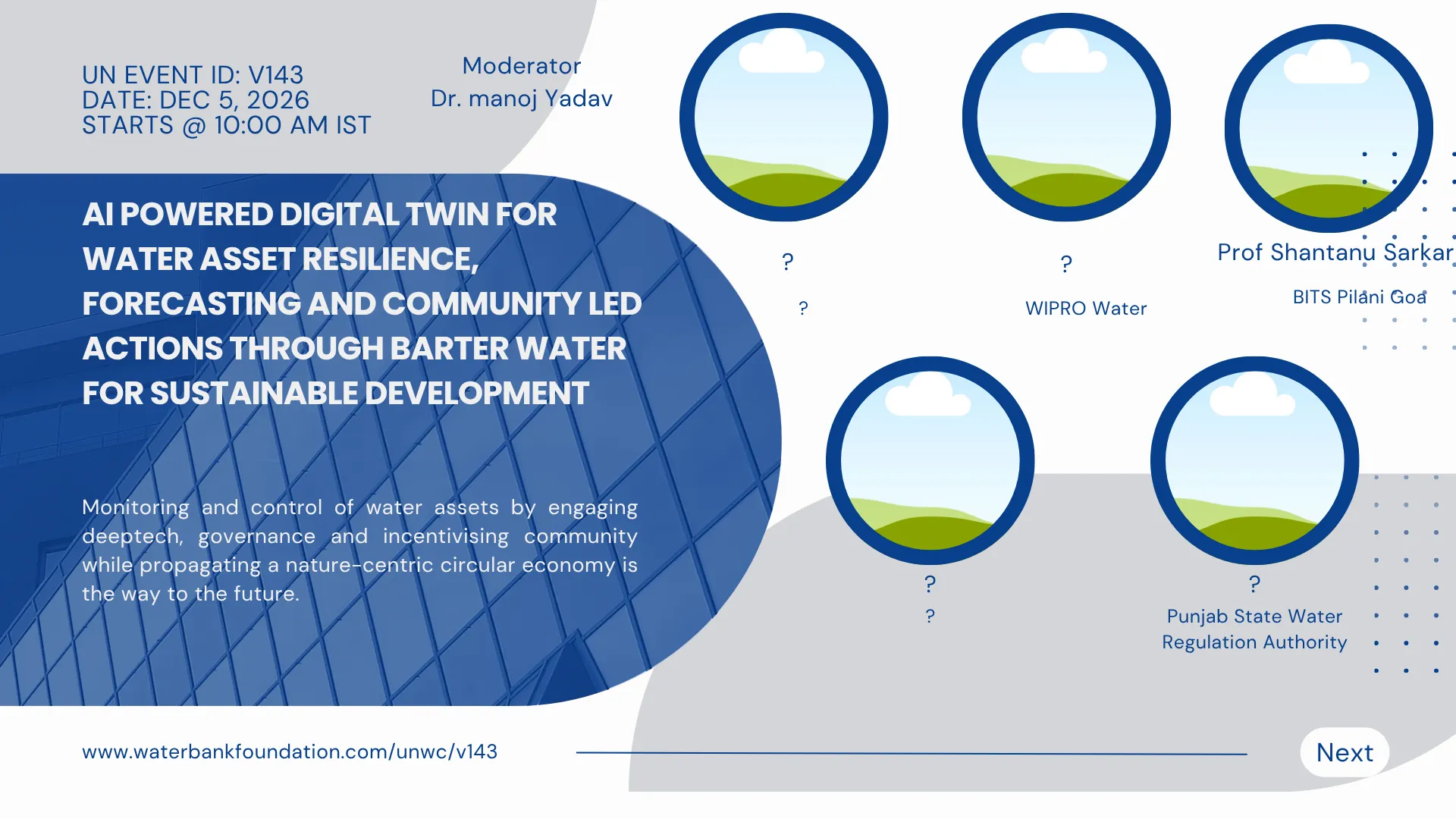

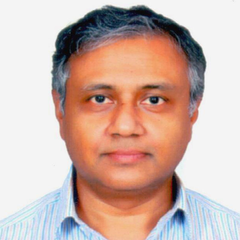
Distinguished Faculty & Panelists
The 2026 United Nations Water Conference will take place from 8–10 December 2026 at the ADNEC Exhibition Centre, Abu Dhabi, co-hosted by the United Arab Emirates and Senegal. The Conference is dedicated to accelerating SDG 6 implementation through practical solutions, financing, innovation and partnerships.
This event is particularly relevant to the Conference's Interactive Dialogues on Water for Planet, Water for Prosperity, Water for Cooperation and Investments for Water. It connects climate resilience and ecosystem protection with technological innovation, community participation and sustainable financing.
Problem and Implementation Challenge
“The fundamental challenge is therefore the absence of an integrated framework connecting water intelligence, predictive technology, accountable local governance and incentivized community action.”
The global water crisis is not merely a crisis of water scarcity; it is increasingly a crisis of deteriorating water quality, failing infrastructure, fragmented governance, ecological degradation and inadequate community participation. Despite substantial investments in water infrastructure, millions continue to experience unsafe water, unreliable services, groundwater depletion, contamination and increasing vulnerability to climate change.
According to the United Nations, 2.1 billion people lack safely managed drinking water and 3.4 billion lack safely managed sanitation. These challenges threaten human health, biodiversity, food security, economic productivity and progress towards Sustainable Development Goal 6.
Existing water management systems are predominantly infrastructure-centric, supply-driven and reactive. Water assets—including aquifers, rivers, reservoirs, pumps, pipelines, treatment plants and household connections—often operate without integrated real-time monitoring, predictive maintenance or reliable water-quality surveillance. Seasonal fluctuations, infrastructure leakages, contamination and changing groundwater conditions frequently remain undetected until substantial damage has occurred.
Conventional monitoring systems are fragmented across departments and jurisdictions. Their dashboards largely report historical information rather than predicting emerging risks, optimizing asset performance or supporting timely preventive interventions. Emerging contaminants, including arsenic, heavy metals, pathogens and microplastics, further expose the limitations of conventional monitoring technologies.
Climate change intensifies these vulnerabilities through droughts, floods, changing rainfall patterns, declining aquifer recharge and coastal seawater intrusion. Meanwhile, inadequate maintenance results in stranded infrastructure, non-revenue water, dry taps and inefficient public expenditure.
Most critically, communities remain passive beneficiaries rather than empowered custodians of their water resources. Local governance institutions frequently lack actionable information, technical capabilities and economic incentives for conservation, water reuse, aquifer rejuvenation and collective stewardship. The fundamental challenge is therefore the absence of an integrated framework connecting water intelligence, predictive technology, accountable local governance and incentivized community action.
Achieving sustainable water security requires transforming water management from a reactive, supply-driven system into a predictive, participatory, nature-centric and circular model that protects water resources while rewarding responsible human behaviour.
Solution Proposed
This event explores partnerships and collaborations to build an integrated, AI-powered Digital Twin and community-led water governance framework that combines advanced monitoring technologies, predictive analytics, decentralized institutions and blockchain-enabled incentives to establish a nature-centric circular water economy.
AIoT-Powered Water Asset Digital Twin
The patented TAP@APP technology supports remote monitoring and control through interconnected sensors and digital infrastructure. A virtual representation of water assets—from aquifers, rivers and reservoirs to pumps, pipelines, treatment plants and household taps—integrates IoT, GIS, satellite data and ground-penetrating radar (GPR) into a unified operational platform.
Predictive Intelligence & Climate Resilience
Artificial Intelligence and Machine Learning models predict water availability, contamination risks, seasonal variations, infrastructure failures and climate-induced disruptions. Predictive intelligence enables proactive maintenance, dynamic distribution optimization and rapid response protocols.
Decentralized, Community-Led Water Governance
Panchayats, local governments, Water User Associations and village water committees are empowered with actionable, transparent data to monitor water assets, enforce equitable distribution, conduct local water audits and mobilize community participation in water stewardship.
Rainbow Credit Incentive Mechanism
BarterWATER proposes a blockchain-enabled incentive mechanism to recognize and reward verified water conservation, groundwater recharge, rainwater harvesting and pollution mitigation, converting conservation into measurable community economic value.
Nature-Centric Circular Water Economy
The platform promotes wastewater reuse, decentralized treatment, ecological restoration and circular resource loops that reduce freshwater abstractions while protecting surrounding aquatic ecosystems.
The narrative positions BarterWATER as an integrated model combining deep technology, decentralized governance, community incentives and a nature-centric circular economy, rather than treating water security merely as an infrastructure or technology challenge.
The Way Forward
The proposed way forward comprises six interconnected priorities to transform water-related commitments into measurable, scalable and community-owned actions through BarterWATER:
Phase 1: Multi-Stakeholder Innovation & Governance Consortium
Create an institutional framework connecting research institutions, governments, water utilities, technology enterprises, civil society organizations and local communities to provide a foundation for scientific research, technology development, policy engagement and community mobilization. Panchayats and WASH Committees will be empowered to undertake local water audits, supervise water assets, promote conservation and facilitate community participation.
Phase 2: Develop & Validate Integrated Water Asset Digital Twin
Undertake a research and demonstration programme integrating IoT, advanced sensors, GIS, GPR, satellite observations, edge computing and AI-based predictive models, piloting it in a cluster of water-stressed habitats to assess water quality, infrastructure performance, groundwater behaviour, environmental vulnerability and community participation.
Phase 3: Establish Measurable Forecasting & Resilience Outcomes
Develop predictive models and early-warning systems for contamination, infrastructure malfunction, aquifer depletion and climate-related disruptions, validated through structured field demonstration pilots.
Phase 4: Institutionalize Rainbow Credits & BarterWATER Circular Economy
Develop a transparent, blockchain-enabled incentive framework for recognizing verified water-positive actions (rainwater harvesting, wastewater reuse, groundwater recharge, pollution prevention). Rainbow Credits and local BarterExchange mechanisms will connect ecological stewardship with livelihood opportunities, entrepreneurship, and community economic participation.
Phase 5: Build an Open, Scalable & Financially Sustainable Ecosystem
Develop interoperable APIs, open-source software components, community-facing applications and policy dashboards capable of integration with existing water management systems. Encourage technology transfer, entrepreneurship, industry partnerships, research commercialization and blended financing to establish financially viable deployment models.
Phase 6: Advance International Cooperation & SDG-Linked Implementation
Leverage the 2026 UN Water Conference to mobilize technical partnerships, institutional commitments, pilot collaborations and investment opportunities. Document verified outcomes and develop replicable implementation guidelines for adoption across diverse geographical, climatic and governance contexts, driving measurable contributions to SDG 6 by 2030.
Consensus Action Declaration for Water Asset Resilience & Circular Economy
The concluding statement of Session V143 establishes commitments across consortium partners to deploy AIoT Digital Twin architectures, institutionalize blockchain-verified Rainbow Credits under BarterWATER, and mobilize blended finance for grassroots water governance.
“An intelligent, predictive, and community-governed circular water ecosystem where cutting-edge technology and local governance converge to guarantee resilient, safe water for all.”
Alignment with the 2026 UN Water Conference
Mapping the contributions of V 143 across the six official Interactive Dialogues of the United Nations Water Conference:

Aquifer protection, ecological restoration, climate resilience, and mitigating groundwater depletion across vulnerable river basins.
Water-use efficiency, nature-centric circular water economy, wastewater reuse, and blockchain-verified Rainbow Credits for conservation.
Safe drinking water monitoring, real-time contamination early warnings (arsenic, heavy metals, pathogens), and community health protection.
Multi-institutional research and decentralized governance bridging academic institutions (IIT Kharagpur, BITS Pilani), tech innovators, and local Panchayats.
Scalable deeptech sensing, technology transfer, public-private partnerships, and innovative blended finance reducing capital risk.
Replicable, measurable contributions to SDG 6, localized accountability metrics, and progressive adoption guidelines across member states.